
The swing sequence is the order in which the body moves during the golf swing. An efficient sequence starts from the ground up, beginning with the lower body, followed by the hips, torso, arms, and finally the club. Proper sequencing allows energy to transfer smoothly through the swing, creating more clubhead speed, solid contact, and consistent ball flight. When the sequence gets out of order, golfers often experience loss of power, inconsistent strikes, slices, hooks, and poor timing. Developing a proper swing sequence is one of the most important fundamentals for building a powerful, repeatable, and efficient golf swing.
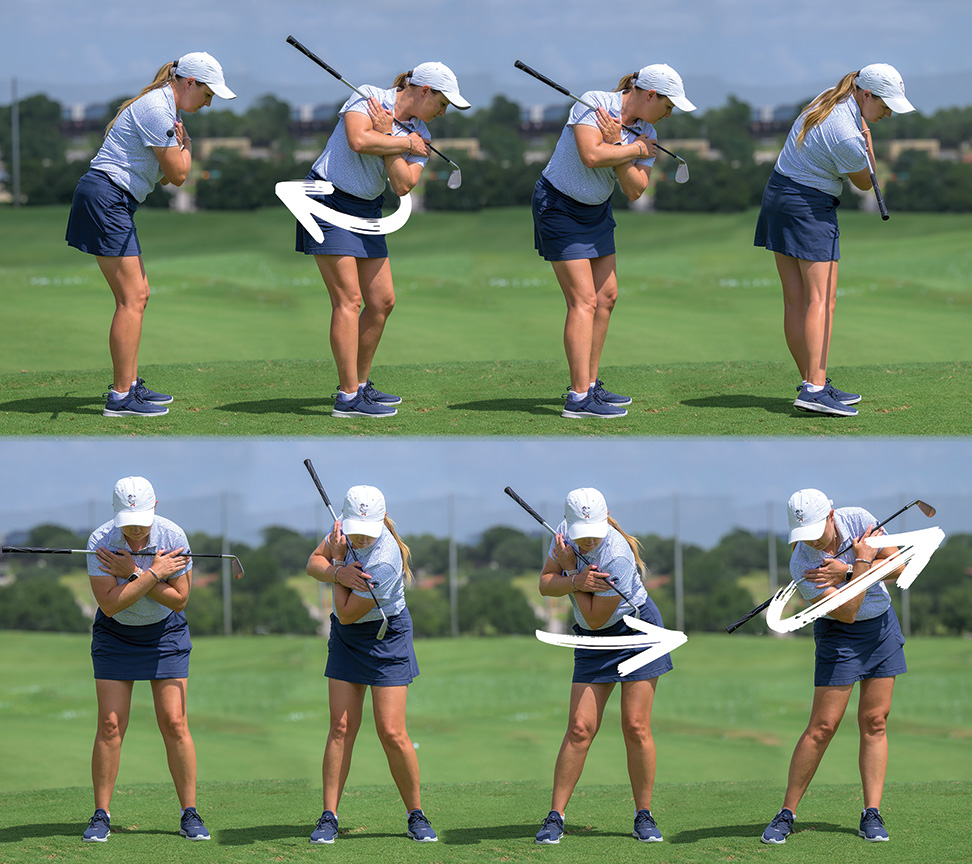
The sequence of the downswing: Shift your hips towards the target, keeping your back to the target as you do then let the arms fall down and lastly open your hips through impact and rise with your legs into the follow through.
Step One: Shift
During the backswing, your pressure should move into your trail leg, creating a stable base to load against. “Rotate into your trail hip/leg”. That load gives you something to push from as you start the downswing. The transition begins by shifting pressure toward your lead side while your head stays behind the ball and back to the target.. As your hips move forward and your upper body remains centered, you create the separation needed for a powerful, efficient swing. This ground-up movement is what great players do to generate speed and strike the ball consistently. A common mistake among higher-handicap golfers is moving their entire body toward the target. Instead of shifting pressure into the lead side while keeping their head back, both the upper and lower body slide together, making it difficult to compress the golf ball and produce consistent contact.
Step 2: Rotate
One of the keys to creating speed is how you use your lead foot during the downswing. Instead of simply trying to rotate your hips, focus on shifting pressure from the toe of your lead foot into your heel. That pressure move helps your lead side work back and creates the rotation your body needs. Using the ground this way allows your hips to open naturally, builds more torque, and helps generate greater clubhead speed without feeling like you’re forcing the swing.
Step 3: Rise to the Finish
As your body finishes rotating through the golf swing, it naturally runs out of range of motion. At that point, it’s important to let your body extend and come out of your posture instead of trying to stay bent over. Allowing your chest to rise through the finish helps protect your lower back, reduces stress on your hips, and lets you generate more power. One of the biggest misconceptions in golf is trying to keep your head down for too long. Once you’ve rotated through the shot, let your body stand tall. I like to tell students that if they’re 5’11” at address, they should feel like they’re 6’0” by the time they reach their finish, finishing balanced and able to hold the finish for three seconds.
When you are working on your swing sequence some things to think about are, the more your shoulders are closed at impact this helps create a draw or hook. The more open your shoulders are at impact this creates a fade or slice.
Kirsten Pike is the Director of Player Development at Las Colinas Country Club. For more tips, follow @kirsten_pgapro on Instagram or call or text 972-399-9040. Please visit www.kirstenpikegolf.com.