
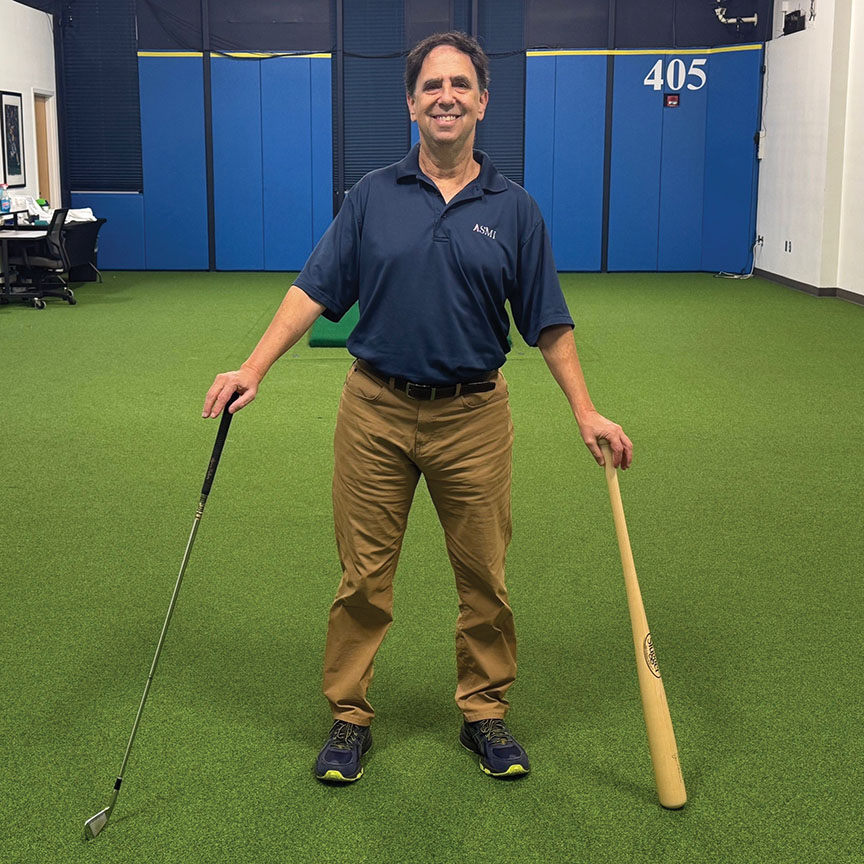
Imagine having the opportunity to interview a man who has appeared in more TV and radio shows, podcasts, and newspaper/magazine articles than almost anyone (no, not Shohei!) and who is also one of the leading sports biomechanists in the world. Meet Glenn Fleisig, Ph.D., of the American Sports Medicine Institute (ASMI).
He has researched the golf swing and believes that there are many parallels between his decades-long main field of study (baseball pitching) and golf. So, listen up golfers, and gain some invaluable insights that you may not find elsewhere.
Dr. Fleisig grew up in New York and always dreamed of becoming a centerfielder for the New York Mets. However, he made his high school math team and not the baseball team, so he decided he needed a pivot. He went on to MIT to become a mechanical engineer, where, while other students were looking at bending and twisting properties of materials, he wandered into a biomechanics lab where the professor was studying–yes, you guessed it – golf! That’s how his senior thesis project became an analysis of a double-pendulum mechanical model of the golf swing.
That could have been the end of it, as he had resigned himself to a job in mechanical engineering while playing sports only for leisure. However, his exposure to biomechanics showed him that he could do both. During an internship at the U.S. Olympic Training Center that followed, he was introduced to a young, up-and-coming doctor – James Andrews.
That doctor, having saved a slip of paper with Glenn Fleisig’s phone number on it for two years (in the days when telephone calls were made over landlines), called Dr. Fleisig two years later to say that the time had come for them to set up ASMI.
And thus, history was made in 1987 – through the establishment of an institute with the specific mission of understanding and helping to prevent sports injuries across various sports. At that time, some research was conducted on the golf swing, because “Biomechanics research works best on sports motions that are repeatable (trying to make the same swing every time) and might lead to overuse injury from repetition.”
Soon Dr Fleisig went on to complete his M.S. and Ph.D. degrees in biomedical engineering, and, in those early years, several golf swing-related papers, book chapters and articles were published. Baseball research soon took over, mainly because baseball pitchers suffered more injuries than golfers, and Dr. Andrews had many baseball patients at his Andrews Sports Medicine clinic.
Given his background in two visually different but biomechanically similar sports, what are the cross-over lessons to be learned? There are several.
In both cases, the goal is to maximize linear velocity of the ball by making a series of angular motions. To do this, “We have to use the kinetic chain, which is a sequence of motions that rotate each body segment at the right time – each joint has muscle force applied across it to produce an angular motion.”
The constraints of the human body must be well understood. How much range of motion each joint possesses, and how much force and power each muscle can apply in each orientation.
The measured motion does not necessarily match what it feels like to the athlete. A challenge for researchers is to determine what to teach the athlete so that the motions they perform produce the movements biomechanists see. For instance, after a pitcher releases the ball, there is pronation of the forearm, but a pitcher does not consciously feel that or try to generate it. So, the idea is always to teach what it should FEEL like, NOT what it should LOOK like. That’s the challenge of coaching in both sports.
Finally, the baseball pitch, the golf swing and all other biomechanical motions have to operate within the laws of physics. For instance, there has to be conservation of angular momentum. When a golfer throws the golf club ‘out’ (by which he means straightening the arms and releasing the wrists so the club moves further away from the body), the ‘moment of inertia’ (reluctance of an object to move) increases, which decreases angular velocity. Conversely if the golf club is kept closer to the body for longer before being thrown out, greater angular velocity could be generated. (Author’s note: how many professional golfers, like Rory McIlroy, start and end with their arms very far from their bodies – what might they achieve with the arms closer to the body for longer!)
What, in Dr. Fleisig’s opinion, MUST happen to make a successful golf swing? The golfer’s flexibility and range of motions should be known, as there’s no point in coaching mechanics if a player cannot make specific movements. And to ingrain proper mechanics, a golfer should train until the movement becomes automatic or subconscious. There should not be any thoughts of mechanics while playing-that’s what practice is for.
One ASMI study published in 2008, titled “Kinematic Analysis of Swing in Pro and Amateur golfers,” found that the highest handicappers (handicap greater than -15) had an average downswing time of 0.34 s, while better golfers had less. What is his opinion on making downswing changes? “It’s not a long time and is true for golf and pitching. You cannot train to make changes during the downswing – train to make changes during the slower parts of motion, i.e. the backswing and initiation of the downswing. During the downswing the player should be on autopilot and the body should just obey the laws of physics.”
Moving from kinematics to kinetics, what is his opinion on the use of force plates? “They are more useful for the golf swing than for baseball pitching. The reason is that the golf swing has more of a ground-up biomechanics and force plates measure the initiation of the golf swing.”
In golf today, force plates measure lateral, rotary and vertical components of the movement. Which components does he believe matter most, and should golfers be trained to intentionally push right to move left, push one foot back and the other forward to create rotation or drop-shift the lead leg to move ‘weight’ towards the target side in the downswing? All the components are important. “What it feels like and what you measure might not match up so we have to teach the proper mechanics that produce the mechanics, not necessarily teach to make ground forces. You should teach what you’re doing with the feet and with body motion, however my warning here is that more is not always better. So you have to have the mechanics that generate the right ground forces and body motions, but overdoing anything might backfire and be counterproductive.”
Do coaches in baseball ask players to make movements that mimic the pros? “Yes and no. We teach pitchers to do some things because the best players do it, and in other things we allow individual variability. For instance, a typical baseball pitch has shoulder abduction and trunk side-tilt at release. We tell players how much shoulder abduction to have (from a medical-injury perspective, based on how the arm fits into the shoulder socket) but allow side trunk tilt to be a personal choice.”
What about your own research – do you also, as seen in most golf research, merely compare club, skill, or injury-level groups and claim experimental results in the absence of true pre- and post-studies comparing one swing style with another?
“Yes, the reality is most research by me and other baseball and golf biomechanists is empirical research comparing different groups. This is very valuable. That being said, there is also great value in experimental research and more such research is needed. Experimental research gives us new ideas to improve biomechanics to make it better than being done today. Thinking outside the box and exploring other swing possibilities is important. I also have a research study underway that thinks outside the box. We are looking into the effect of increasing ball weight from 5 to 6 oz. to discover whether that will reduce elbow torque and injury risk.”
So what’s next for this talented, extremely knowledgeable sports biomechanist? To continue with research and publications, to increase outreach and education through media and social media (his @the_biomechanical_man posts on Instagram are not to be missed), to continue to promote the American Baseball Biomechanics Society that he set up with colleagues, and to continue to mentor future sports biomechanists (they have had 250 interns in the past 32 years, many of whom have gone on to have careers in motion analysis and in sports medicine). And, of course, to play in his weekend softball group!
Dr. Fleisig has had a considerable influence in sports biomechanics, and there are many valuable lessons golfers can learn from him.